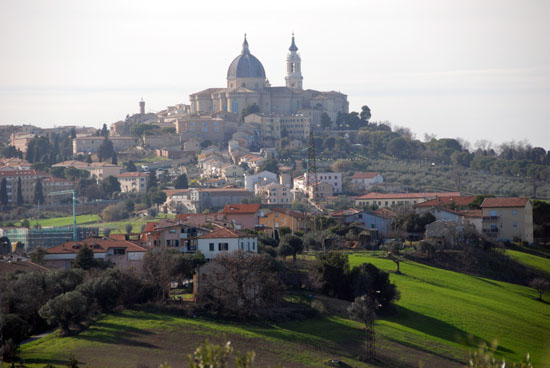
City on a rock
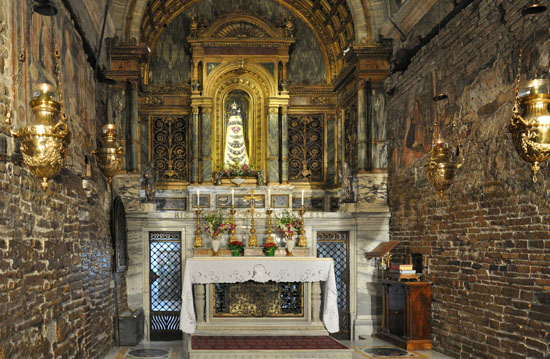
A city on a rock, among gentle rolling hills, towering over the turquoise murmur of the Adriatic - Loreto. Whoever comes here returns transformed, "enchanted" by God's mystery. The fifteenth-century, mighty city walls hide a treasure - a sanctuary that contains the house of Nazareth of Mary, like a "casket with a pearl" - as noted by St. Teresa of Lisieux, who made a pilgrimage here in 1887. Despite the numerous pilgrims arriving, the sanctuary, enveloped in prayerful silence, appears as a wondrous place, introducing one into the mystery of God's love and mercy.

The Holy House - Icon of the Incarnation
Everything around seems to participate in the great mystery: the beauty of gentle hills, the solar pastels spreading across the vault of heaven, the harmony of sea colors of organs praising the Creator for the work of salvation. And it is no wonder, the true witnesses of the arrival of the Holy House, amazed and speechless - as legendary accounts proclaim - were - besides the shepherds grazing flocks on the slopes of Mount Conero and fishermen - nature itself: the sea, sun and stars, clouds and trees, paying homage to the arriving sacred relic. In commemoration of this event, to this day, on the anniversary of that night, residents of the Marche region and surrounding areas light bonfires to illuminate the path of the arriving "icon of the Incarnation." And yet the extraordinary relic kindles - how much more ardent - divine fires in the hearts of pilgrims coming here!
Blessed Frances Siedliska in Loreto
This was experienced in an extraordinary way by the foundress of the Congregation of Sisters of the Holy Family of Nazareth - Mary of Jesus the Good Shepherd (Frances Siedliska), for whom Loreto was a special place. The number of her frequent visits to the sanctuary testifies to this. It was there, in the House of Loreto, representing the unique moment in history that initiated God's salvific plans, in a place that has been for centuries the true Marian heart of Christianity - that she discovered the mystery of the Holy Family of Nazareth, which she adopted as the spiritual model for her Congregation.
"Never (before) did the Lord Jesus make me understand so clearly what this Holy Little House means to us and what we should be, having received this mercy of being children of the Holy Family, and these three holiest persons on earth are given to us as a model to imitate."
- In the record of Mother Frances Siedliska's Diary, from her stay in Loreto, July 1895
Enchanted by the silence and prayerful peace of this place, she stayed for at least a day, several days, in the northern wing of the Apostolic Palace at number 85. However, she spent little time in her room; immersed in the prayerful space of the Holy House, she explored with an open heart the Event - not an abstract doctrine, the first chord of God's salvific plan. Did she already know then that she would become one of the significant tones of the Song of God's Mercy over the world? We do not know this. We do know, however, that her time spent in the House of Loreto was devoted to conversation with Mary - the Woman and, if one may say so, the "space" - as Pope John Paul II would say - the physical and spiritual space in which the INCARNATION took place.
Therefore, Mother Mary of Jesus the Good Shepherd made pilgrimages to the Sanctuary for important matters concerning the Congregation. She believed that the life and development of the new institute in the Church was closely connected with this holy place, where the mystery of the life of the Holy Family of Nazareth enchanted her and penetrated her with its divine light. Participating here in the Eucharistic extension of the mystery of the Incarnation, Mother Mary of Jesus the Good Shepherd drew divine strength to make key decisions and lead the new religious family under the inspiration of the Holy Spirit, for whom Mary's house is a special space.
It is no wonder that the place which - as John Paul II says - helps to rediscover each time anew the wonder, adoration and silence necessary in the face of such a great mystery became for the Foundress of the Nazareth Sisters a point of departure and arrival; as facts testify - also an inspiration for the spiritual construction of the House - Nazareth. During the formation of the spiritual profile of the Congregation, she sought light in the House of Loreto, asking Mary - the Bride of the Holy Spirit - who is most fully present here, for the gift of discernment. For she desired that the newly formed Congregation could follow in the Church its own distinctive charismatic current, according to the inspiration placed in her heart by the Holy Spirit. And this is indeed a time of difficult beginnings, when proposals come from everywhere to attach the Institute to existing congregations. Therefore, it cannot be surprising that initially she called the mother house Loreto. Only somewhat later did the final name Nazareth crystallize, as a space and ideal of holy life, whose unique icon is contained in the Basilica of Loreto.
Frances Siedliska often advised her spiritual daughters: Transport yourself in thought to (...) the Little House of Loreto, breathe for a moment that divine spirit that reigned here when the Holy Family lived in it and think that all these miseries will soon pass... Moreover, her desire was to create a house for the Nazareth Sisters near the sanctuary, hiding under monumental domes small stones penetrated by Mystery - witnesses of the miraculous revelation of God in human history.
House of the Polish Sisters
The presence of the Nazareth Sisters in Loreto is therefore not accidental. They have grown into the landscape of Loreto's hills and valleys, becoming part of the community of this extraordinary city, for as we read in the guidebook entitled "Polish Memorials in Loreto": There is in Loreto one living document that daily makes Poland present here. Near the Basilica of Loreto, at Via Maccari 7, is the convent of the Sisters of the Holy Family of Nazareth, commonly known here as the "House of the Polish Sisters".
(...) Extensive and worthy of detailed study is the contribution of the Nazareth Sisters in organizing and providing assistance to Polish soldiers who remained in Italy after the end of World War II. The Sisters also admirably distinguished themselves in work on reuniting Polish families separated during the wartime turmoil. Particularly noteworthy is the Sisters' care for Polish orphans, to whom they provided shelter in their house. In their Samaritan service to their neighbors, they were not limited only to Poles, thus gaining the sympathy of foreigners, especially Italians.
Apostolic work
Indeed, from the moment the Nazareth Sisters appeared in Loreto, i.e., from 1946, thanks to the preceding efforts (1941) of the Superior General of the Congregation Mother Laureta Lubowidka, they had no shortage of work to do. Although they were initially tenants of the house of the Sisters of the Good Shepherd, and the walls of Nazareth were still being built, they noted in the chronicle: Youth from everywhere flocks to us, whom we try to help in learning. The cramped little room, the sisters' first shelter, depending on the time of day, turns into a parlor, school, and sacristy.
The long-awaited day, under the patronage of Christ the King, 1948 - the day of the consecration of the chapel and then the Sisters' own house - began a new stage of apostolic activities by the daughters of Frances Siedliska, who from then on would embrace with an even greater wave of Nazareth spirit people and places calling for their presence. The sounds of children's joy from Polish orphans, but also foreign language lessons, educational lectures on drawing, music, or catechetical meetings, turning into living encounters with God in prayer - would become an inseparable part of the atmosphere of the Nazareth house. The so-called camps for girls and trips with children organized from 1949 would finally reveal the presence of good Polish sisters to residents of more distant areas. The doors of Nazareth open both to the poor, who were not lacking in those times, and to the increasingly numerous pilgrims arriving from Poland and Polish centers in England and the United States.
Guardians of the Polish cemetery
The Loreto Nazareth Sisters also became guardians of the cemetery of Polish soldiers resting at the foot of the basilica, which they so heroically defended from fire, despite the battles raging nearby, despite the lack of proper equipment and the height of monumental walls requiring acrobatic skills. Since 1946, when General Władysław Anders sent a written request to the then Superior General of the Congregation Mother Bożena Staczyńska, the Nazareth Sisters took caring custody of the resting place of Polish soldiers. Rich documentation of the efforts of the superior of the house in Loreto in the years 1959-1965, Sister M. Ezechieli Szupenko for necessary funds from Italian authorities, also her contacts with Archbishop Gawlina, General Anders and Polish emigration, finally the Committee for Care of 2nd Corps Cemeteries in Italy awarded the Golden Cross of Merit for activity in the field of national and social work, as well as chronicle entries of the Nazareth Sisters from Loreto, eloquently testify to the sisters' many years of efforts and zeal in maintaining three cemetery terraces at the foot of the basilica, so that the sons of our homeland could rest with dignity at the house of the Best Mother. In the chronicle of the Nazareth Sisters from Loreto we read, among others: Hearts were filled with joy at the sight of the cemetery: restored wall and walls covered with a mass of blooming roses (...) General Anders went to the house of the SS. Nazareth Sisters with thanks. The Nazareth Sisters are spiritual and moral guardians of the cemetery. Like good angels they watch over the realization of the words of the epitaph placed on the pilaster of the Chapel of Christ Crucified, situated above the graves:
(...) May this heavenly Lady lull you
To eternal sleep of love.
May the wind from the nearby sea and from this hill
Blow gently over you.
Murmuring, may it bring from afar
The tender words of your mothers and wives (...)
Recognition of John Paul II
Father Hieronim Warachim (Capuchin), in the mentioned guidebook, thus defines the role of the Polish sisters: Currently, the monastery of the Nazareth Sisters in Loreto serves as a haven for pilgrims and tourists, especially the sick who come to Our Lady of Loreto. The hospitality and kindness of the Sisters is a constant testimony to Polish culture.
Appreciating the role of this living testimony to Polish heritage, John Paul II during his pilgrimage to Loreto (September 8, 1979) did not omit the house of the Nazareth Sisters, and by praying in the chapel of this Congregation, he emphasized the important role it played in the past and continues to play daily.
The Nazareth Sisters from Loreto are known today not only to the residents of Marche, but also to numerous pilgrims coming from various parts of the world, especially pilgrims from Poland, staying in the hospitable house of the sisters, who find time for the best part, cultivated with love during long spiritual conversations in the House of the Best Mother. The continuators of the spiritual legacy of Blessed Mary of Jesus the Good Shepherd often make pilgrimages to the Loreto sanctuary, especially at important moments in the life of their Congregation, to offer thanksgiving to the Mother "full of grace," and to spread this grace like a rainbow of love over the entire Christian world.
S.M. Noela Wojtatowicz CSFN
Visit the Sanctuary
Experience the spiritual atmosphere of Loreto and learn about the history of the Holy House of the Blessed Virgin Mary